Sunday, February 28, 2016
TOW #19 - Text
In “All About Adam,” the author, discusses the everlasting debate over evolution and creationism. They address how recent scientific evidence for evolution, particularly new evidence that shows that humans are not all descended from two individuals, is stirring up some problems for creationists. Scientific evidence is pushing the creationist envelopes and forcing some to turn to imperative ways to ensure faith in the Christian religion. Wheaton College, a Christian liberal arts school obliged their faculty members to sign faith statements declaring that God directly created Adam and Eve. The author noted that old-time religion has always been strong in America but the generation of the millennials, (those born between the early 1980s and 2000s), are drifting away from their stern and strict denominations. For example, this generation is more accepting of the LGBT community. The author’s purpose is to address the ongoing debate of evolution and creationism and to show how creationists are struggling with growing evidence of evolution and skeptical youth. The audience is Americans on both sides of the issue: creationists, perhaps to inflict some concern, and those who believe in evolution, to show a growth in that belief. This article is also for an international audience to learn about the pressing religious debate in America. One of the most effective rhetorical devices is a comparison between the trial that Galileo had for insisting that the Earth circled the sun and this current debate of evolutionism and creationism. When referring back to the history of Galileo’s trial, most people feel that the church was wrong because Galileo and science turned out to be right. By comparing this to modern day, the author challenges readers to consider whether creationism is similarly wrong. The author did achieve the article’s purpose by describing the conflict among creationists and by using statistics to illustrate the changes. Although it is not clear who wrote the article, The Economist is an internationally respected magazine. The use of statistics and quotes from religious scholars lends credibility to the article.


Sunday, February 21, 2016
TOW #18 - Visual
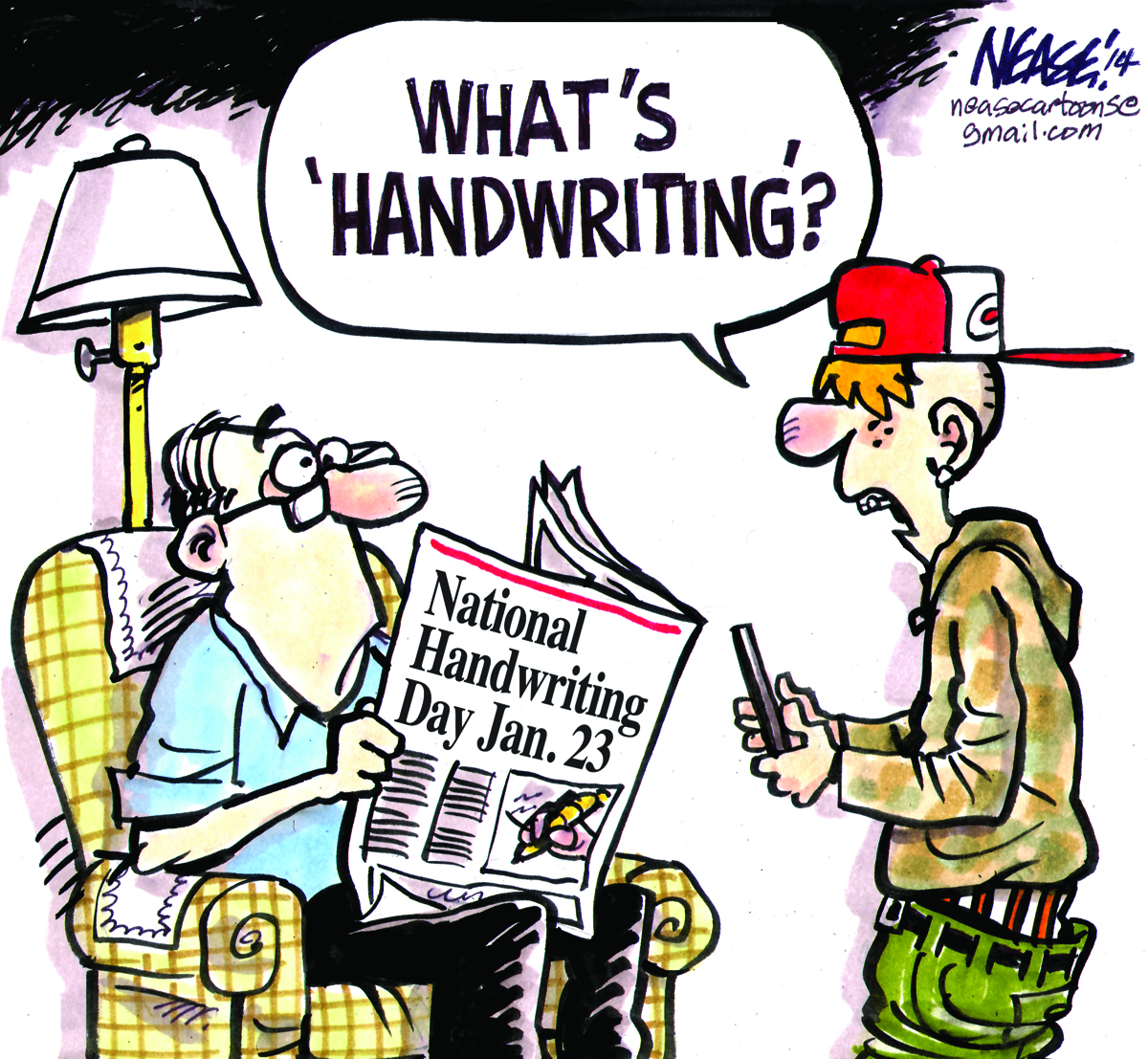
A very prevalent issue in today's society is our attachment to our smartphones and electronic devices. We, including me, hold to them so dearly and can find ourselves on them longer than not. Teenagers and young adults especially are constantly stuck to their phones, checking their Snapchat or making sure they get likes on their latest Instagram upload. On top of that, they're texting each other nonstop. In a cartoon by political cartoonist Steve Nease, a teenage boy is shown asking his father, "What's 'handwriting'?" The father, who is holding a newspaper that a has a headline that says, "National Handwriting Day - Jan. 23," is looking at his son, who appears to be in the midst of texting on his phone, in amazement. Nease juxtaposes the teenager with the teenager's father through the clothes that they are wearing and the thing in their hands. This creates a distinct difference between the teenager's generation and the father's generation by using stereotypes of how they act. He also uses the teenager's confusion to represent the majority of the current generation's lack of understanding of what it means to write by hand, instead of by phone. I find this cartoon effective on a personal level, because I too am guilty of using my phone and computer a lot. Although I don't really expect to change my habits and use my phone or computer less, it is a reminder of the direction our generation has already set a course for: a digital era. In some aspects, it's impossible to give up some electronics because of the way our global society, government, and economy are set up. They depend on our use of digital devices and wouldn't function otherwise.

Monday, February 15, 2016
TOW #17 - Text
In her article about the position of women in today's economy, Stephanie Coontz, an author, historian, and faculty member of Evergreen State College, argues that rather than first looking to help women shatter the glass ceiling (the forces keeping women from entering the higher rungs of the corporate ladder despite their accomplishments) the nation should focus on "the sinking floor", which is the growing problem of both men and women struggling with poverty. She says that female-based models to address this will be more effective, rather than the former masculine-based model constructed around the idea of a male breadwinner. In the past, it was mostly women who have worked the lower-wage jobs, but now, an increasing number of men are facing the same problems. By helping reduce the wage gap through implementing a "livable" minimum wage, establishing a wider safety net, and prioritizing child care, both men and women can be helped.
Coontz appeals to logos and uses repetition to further her argument. She says, " 2009, one in every four American workers earned less than two-thirds of the national median hourly wage, the highest proportion of low-wage work in 19 Organization for Economic Cooperation and Development countries, according to the economist John Schmitt of the Center for Economic and Policy Research." Coontz also establishes that the highest proportion of stay-at-home moms are married to men in the bottom 25% of wage earners. These statistics show that by helping the lower wage earners, men and women can both be helped. Towards the end she repeats the phrase "putting women first", which means that these policies are directly linked to putting women first but will greatly benefit men at the same time.
Coontz does not fully achieve her purpose because her "although" type thesis spends too much time on the "although" part and therefore slightly confuses her reader as to whether or not we should continue to pursue female-oriented policies even though women seem to be clearly doing better despite after the recession while men are still struggling. Her audience is probably policy-makers but also the general public.
Coontz appeals to logos and uses repetition to further her argument. She says, " 2009, one in every four American workers earned less than two-thirds of the national median hourly wage, the highest proportion of low-wage work in 19 Organization for Economic Cooperation and Development countries, according to the economist John Schmitt of the Center for Economic and Policy Research." Coontz also establishes that the highest proportion of stay-at-home moms are married to men in the bottom 25% of wage earners. These statistics show that by helping the lower wage earners, men and women can both be helped. Towards the end she repeats the phrase "putting women first", which means that these policies are directly linked to putting women first but will greatly benefit men at the same time.
Coontz does not fully achieve her purpose because her "although" type thesis spends too much time on the "although" part and therefore slightly confuses her reader as to whether or not we should continue to pursue female-oriented policies even though women seem to be clearly doing better despite after the recession while men are still struggling. Her audience is probably policy-makers but also the general public.
Sunday, January 31, 2016
IRB Intro Post #3
For the third marking period, I chose to read Fear Itself by Rush W. Dozier, Jr. Browsing through the public library, I came across this book and thought it would be interesting to learn more about the ways that one of the most important human emotions, fear, shapes our lives and our world. Fear is evidently very prevalent in all of our lives, but we pay so little attention to where it comes from or the deeper purpose it serves. I hope to understand these things so that I can be aware of how my emotions are controlling me.
Sunday, January 24, 2016
TOW #16 - IRB
Getting through the rest of Unbroken was a bit harder than I expected over the past few weeks because of midterms and other tests, as well as this weekend's blizzard. To make the situation worse, the second half of Unbroken was far less exciting than the first in my opinion. While Louie's camp was liberated and he was sent home at the end of World War II, gets married, and has a religious awakening, there was a considerably smaller amount of action. Nevertheless, the second half of Unbroken is undoubtedly the more important one. During his time in the concentration camps, he is constantly beaten by the relentless Watanabe, the concentration camp warden. However, during one of his punishments in which he had to hold a heavy wooden beam over his head, Louie is victorious in this psychological battle between him and Watanabe by refusing to be proven weak. This climactic point substantiates the title, Unbroken, by showing his mental and physical resilience, even after everything he went through. On several occasions, Laura Hillenbrand, the author, explains that the key to survival through such difficult times is through the preservation of human dignity. She illustrates with Louie’s story that the men that had maintained their humanity and dignity, despite horrific inhumane treatment, were the ones that had a much stronger chance of survival. Long after the body was physically capable of staying alive, Louie, along with other men, managed to survive through little rebellious acts, which kept their spirits unbroken and thus, their individuality intact. Louie acquired a journal and pencil from another captive of Yokohama, and he admitted that “this small declaration of self a great deal” to him (204). Mac, the third crash survivor on the life raft, did not survive at sea, despite eating all of the survival chocolate. He remained sullen and quiet, and at times, gave up hope. His example strengthens Hillenbrand’s thesis, that a fighting spirit that remains unbroken can survive anything.
Sunday, January 17, 2016
TOW #15 - Text
In one of their articles, The Onion, infamous for its satire, discusses a NASA mission that discovered a planet identical to Earth by using an orbital mirror. The article makes absurd claims about scientific discoveries made with the mirror throughout. At the beginning of the article, The Onion writes, “According to NASA, the $2.9 billion aluminum glass mirror… suggesting that our solar system may contain a terrestrial planet of the exact same size, shape, and surface composition as Earth” (par. 2). Later in the article, they compare the two planets, discussing how they are exactly the same is water composition, period of rotation, and axial tilt. The idea of a space mirror is absurd enough, but The Onion continues to mock the usage of NASA by using these comparisons as emphasis. In this way, the author is able to convince readers of a downfall in NASA’s practical days, since the article makes it look like NASA is only being used for absurd missions nowadays. Continuing through the article, there are also examples of irony used in order to show the absurdity of the theoretical space mirror. The article states, “’What may be even more surprising is that it was discovered in a part of space that was previously thought to be completely empty’” (par. 3). This shows the absurdity of the mirror because the word “surprising” is ironic. Although it is meant to show the scale of the discovery, in reality, it just emphasizes the fact that the mirror was just used for satirical purposes. The mirror is used by The Onion as a symbol of NASA's lost practicality and glory. At other points throughout the article, irony is used to emphasize this, and it is the irony itself that really is key in showing the problem with NASA. With funding for NASA missions dwindling, the article came at the perfect time. It was meant to ridicule that missing funding, and its use of irony and dubious claims are effective in doing so. Readers are left to think about the problems with NASA's funding and glory today, and The Onion hopes to bring change with that.
Sunday, January 10, 2016
TOW #14 - Text
A rather controversial article on Townhall seems to want to debate president John F. Kennedy's real role in the mid 20th century. This essay starts off relevant, posing plausible questions and presenting facts, but after the halfway point starts to go off on a rant. This essays good logos supports its argument well but it tears itself down with is condescending tone in the second half of its argument. Derek Hunter, the author of this article, starts his argument with some well researched facts and historical events. Hunter brings to light the fact that JFK was not sure for reelection and the idea that he was not involved in all of the positives that he is traditionally associated with. These are all well supported facts and historical contexts that are all relevant and support his argument; but in the next few paragraphs Hunter's argument takes a turn for the worst. In the second half of his essay, Hunter begins to use slandering and degrading diction which devalues his argument. He starts to use words that are meant to attack the former president calling him things like, "despicable" and a, "fraud." This type of slanted diction makes Hunter seem biased and ignorant which renders his pervious argument less effective. Not only does he attack the president, he also attacks his family, even criticizing the placement of their final resting places. Hunter also fails to recognize a counterargument; the opinion that JFK was in fact a good president that accomplished many things. Hunter's diction renders his argument completely ineffective and his lack of recognition for the good things the president has done makes him seem ill researched and cynial.
Subscribe to:
Posts (Atom)